
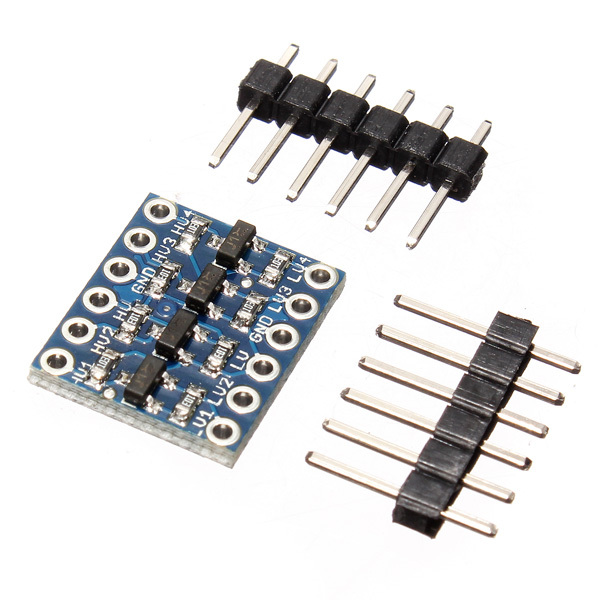


I2C Bi-Directional Logic Level Converter (4-Channel)
- Essential Bi-Directional Logic Level Converter for safe communication between devices with different voltage levels (e.g., 5V and 3.3V).
- Four independent channels allow simultaneous conversion for up to two I2C buses (SCL/SDA) or four general digital signals.
- Utilizes the BSS138 MOSFET design, providing automatic bi-directional voltage translation without direction pins.
- Ideal for connecting 3.3V microcontrollers (like Raspberry Pi, ESP32) to 5V sensors (like Arduino, older modules) and vice-versa.
- Supports common logic standards, including I2C, SPI, UART, and general digital IO.
Product Details
I2C Bi-Directional Logic Level Converter - 4 Channel (BSS138 MOSFET Based)
The Logic Level Converter is a critical component when interfacing integrated circuits (ICs) and sensors that operate at different voltage levels. Most modern microcontrollers (like the ESP32 and STM32) operate at 3.3V, while many legacy sensors, Arduino boards, and peripherals still run at 5V. Directly connecting these devices can damage the lower voltage component.
This particular module features four conversion channels and is built around the reliable BSS138 MOSFET design, which is essential for I2C communication. The design allows for bi-directional translation on each line, meaning a signal can travel safely from the high voltage (HV) side to the low voltage (LV) side, and vice-versa, without the need for manual control or direction setting—a requirement for the I2C protocol (SDA and SCL are bi-directional). It operates by supplying both the high (HV) and low (LV) reference voltages to the board.
🔧 Key Features
- Channels: 4 independent channels for logic conversion.
- Function: Bi-directional and Uni-directional voltage level shifting.
- Component Used: BSS138 N-Channel MOSFET.
- Supported Protocols: I2C (SDA, SCL), SPI, UART, and standard GPIO.
- Voltage Compatibility (LV): 1.8V to 3.3V (typically 3.3V).
- Voltage Compatibility (HV): 3.3V to 5V (typically 5V).
💡 Applications
- Connecting a 5V Arduino Uno to a 3.3V sensor (e.g., a modern barometer or gyro).
- Interfacing a 3.3V Raspberry Pi/ESP32 with 5V I2C devices.
- Converting level for digital peripherals that require different logic voltages.
- Used extensively in robotics and IoT projects where different voltage standards coexist.
⚙ Technical Specifications Summary
| Module Type | Logic Level Converter (I2C Bi-Directional) |
| Conversion Range | 1.8V to 5.5V (LV side) / 3.3V to 5.5V (HV side) |
| Number of Channels | 4 |
| Circuitry | MOSFET based (BSS138) with integrated pull-up resistors |
| Dimensions (L×W) | Approx. 1.5 cm × 1.3 cm |
| Mounting | Breadboard friendly 2.54 mm pitch header pins |
| Maximum Speed | Limited by I2C capacitance and pull-up resistor values (typically up to 400 kHz) |
🔌 Wiring Diagram Overview
| Pin | Function | Connects To |
| HV | High Voltage Supply | 5V Supply (e.g., Arduino VCC) |
| LV | Low Voltage Supply | 3.3V Supply (e.g., Raspberry Pi VCC) |
| GND | Ground | Common Ground |
| HV1 - HV4 | High Voltage I/O Pins | 5V Device Data/Clock Lines (SDA/SCL) |
| LV1 - LV4 | Low Voltage I/O Pins | 3.3V Controller Data/Clock Lines (SDA/SCL) |
📦 Package Includes
- 1 × I2C Bi-Directional Logic Level Converter - 4 Channel
- 2 × 5-pin Header Strips (Unsoldered)
Specifications
- ProtocolI2C
- Output PinsSDA/SCL (for Compass)
- CompatibilityLCD Display and Others
- ICPCF8574